

Product Specifications
|
Parameter |
Specification |
|
Common materials / tempers |
6063-T5/T6; 6005-T5 |
|
Forming method |
Stretch bending, roll bending or dedicated forming die after extrusion |
|
Wall thickness |
0.8–10 mm |
|
Minimum bend radius |
Generally no less than 8–10 × profile height or width, subject to section geometry and alloy temper |
|
Dimensional tolerance |
GB/T 5237.1-2017 or EN 755-9, as applicable |
Curved Profiles Formed After Extrusion
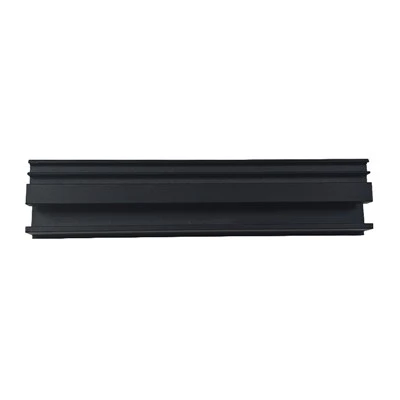
Curved Aluminium Extrusion starts with a straight extruded profile, which is then bent using stretch bending, roll bending or a dedicated forming die. The radius, arc length and bending angle are specified according to the customer's drawing. Wall thickness ranges from 0.8–10 mm. Forming the profile in one piece eliminates the welded joints and seams that may be required when fabricating a curve from separate sections, resulting in a cleaner finished appearance.
Alloy Selection and Bend Radius
6063-T5/T6 is commonly used for its formability, helping control springback and reduce the risk of surface cracking during bending. 6005-T5 is also available. Typical mechanical properties for 6063-T5 are Rm ≥ 160 MPa and Rp0.2 ≥ 110 MPa. As a general guideline, the minimum bend radius is typically no less than 8–10 times the profile height or width, subject to the section geometry and alloy temper. Radius and arc-profile tolerances are specified according to GB/T 5237.1-2017 or EN 755-9, as applicable. Finished parts are supplied to the required arc length and assembly dimensions.


Applications in Architecture and Display Systems
Typical applications include curved curtain wall sections, curved windows and canopies, interior trim, exhibition stand structures, advertising signage, automotive roof rails, curved furniture frames and curved track sections. Where a profile must meet both structural or functional requirements and a specific curved shape, the section design and bending process can be evaluated together.
Surface Finishing, Tooling and Quality Control
Anodizing, powder coating and electrophoresis can be applied after bending. Surface coverage and finish consistency are checked across the curved sections. Packaging is selected to accommodate the part geometry and help prevent deformation during transport.
New profiles can be developed from architectural or decorative drawings. The factory reviews the required radius, arc length and section formability, and provides guidance on the bending process. Quality records are maintained from incoming material inspection through final inspection to support traceability. Material certificates and test reports are provided, and third-party inspection is accepted. Domestic sample development takes 7–10 days, with delivery schedules confirmed when the order is placed.
Hot Tags: curved aluminium extrusion, China curved aluminium extrusion manufacturers, suppliers, factory, aluminum extrusions, Black Anodized Aluminum Extrusion, Curved Aluminium Extrusion, Precision Aluminum Extrusion, Small Aluminium Extrusions, T Track Aluminium Extrusion